Replace the workflow

Malhar Singh is Head of Growth Product at Wispr Flow, the voice-to-text AI that turns speech into polished text in every app, and growing 40% month-over-month. Previously, he scaled new product lines at Noom to hundreds of millions in ARR, and earlier worked on consumer products used by millions at Zynga.
In this entry, Malhar argues activation is the moment a user replaces an existing workflow with your product. To really activate your users, you need to design onboarding for self-segmentation, define the metric that tells you it’s working, break the priors getting in the way, and use those aha moments as a growth lever.
You need to replace a workflow
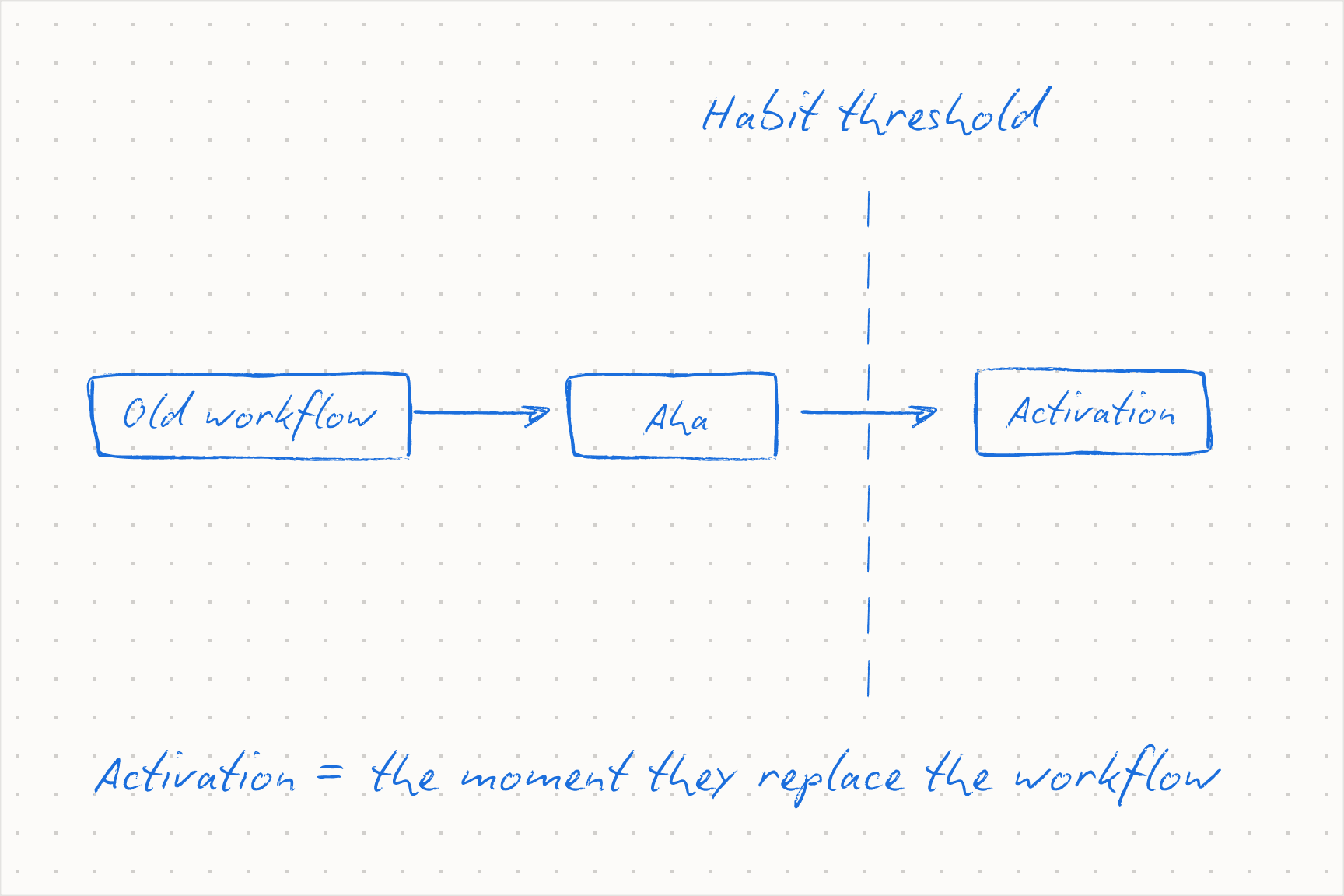
Right now, there’s a lot of talk about the difference between the aha moment and the activation moment. The aha moment is the point at which the user says: this is interesting — this actually has the potential to replace what I do today. Activation is the moment they actually do. It’s where your user has crossed the threshold into the space where forming a habit becomes inevitable, and they’re willing to replace their real workflow with your product.
It’s not easy, and it’s getting harder with more horizontal AI tools. When the product can do anything, the user faces a blank canvas and doesn’t know where to start. Finding the right and tailored aha moment for that specific user matters now more than it ever has.
Cluster the secondary aha moments
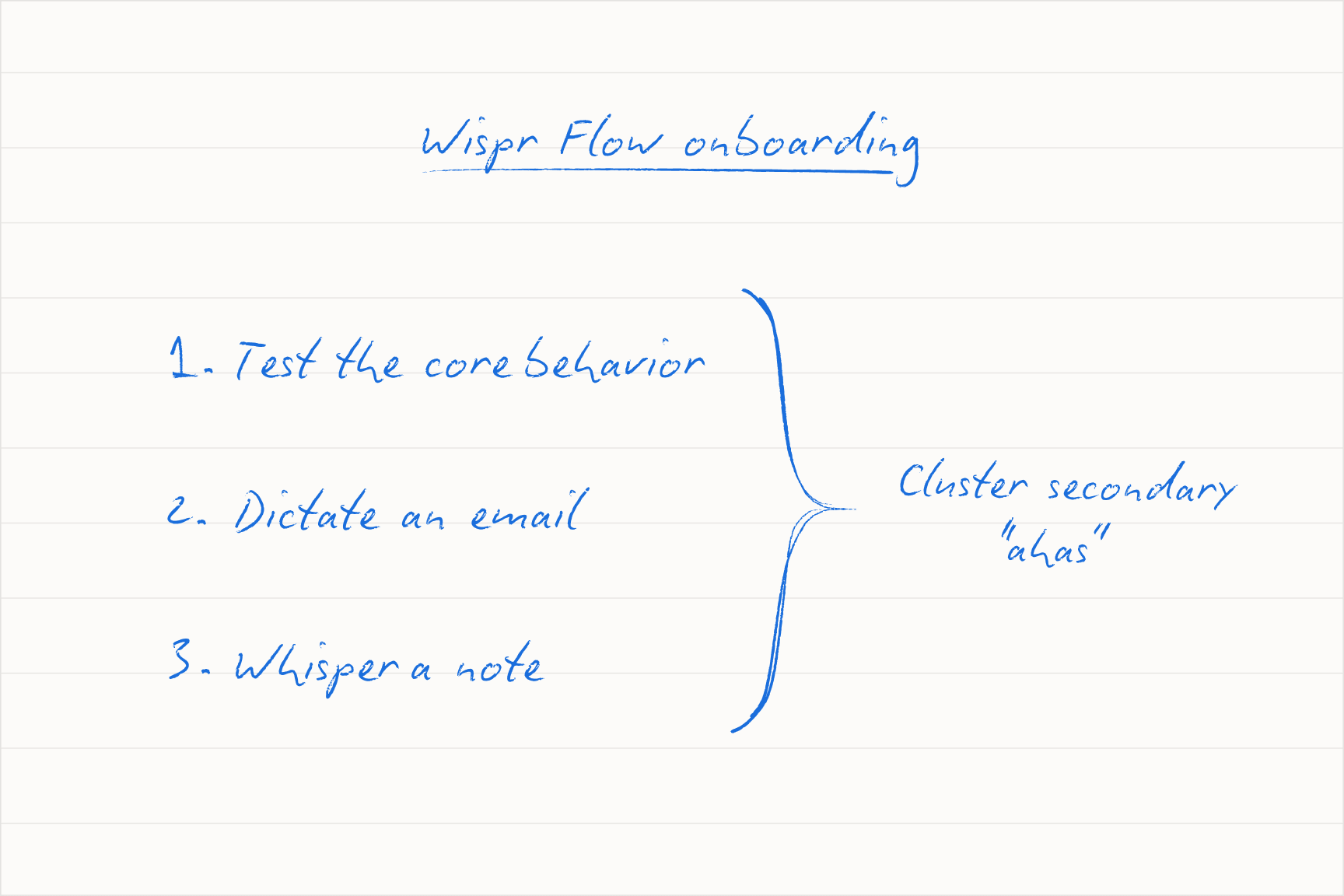
A lot of this work happens in onboarding. At Wispr, our old onboarding made you dictate once into a simulated Slack message box and the “testing” experience ended there. We replaced it with three explicit use cases:
- Testing the core behavior needed.
- Dictating an email and seeing it automatically format for you.
- Whispering a note to see the product understands you even when you’re quiet.
You want every prospect to see their workflow reflected in your onboarding, alongside associated product mechanics. Without this, you’re just hoping they discover product value instead of letting them experience it upfront.
After three use cases, we’ve walked our users through finding the workflow that fits them and teased the long tail of what’s possible after they’ve adopted their first workflow. Crucially, the two use cases that aren’t theirs yet don’t go to waste:
After three use cases, we’ve walked our users through finding the workflow that fits them and teased the long tail of what’s possible after they’ve adopted their first workflow. Crucially, the two use cases that aren’t theirs yet don’t go to waste:
- For the user, they become secondary aha moments that they’ll come back to. Maybe they’re working from home, so they don’t care about whispering right now. Maybe they’re a developer, so they don’t send that many emails.
- Beyond the individual, they become referral moments. The developer who doesn’t email now has a reason to tell their marketing partner, their product partner, their CEO: hey, this thing works really well for email, you should try it.
This is something Claude and other AI tools are starting to do really well. They give you multiple options and you end up starting with just one, but you subconsciously log the others. You don’t want to overload people with twenty use cases, but you do want to give them an idea of secondary ahas that apply to someone else, or to themselves later on.
With a horizontal product, find one good workflow, get the user activated on that, and then nudge them toward the next. A mistake we found is trying to push people to try multiple workflows before they’ve built a habit with one. You can expose people to multiple workflows, but you should only push the 2nd or 3rd once the first one has been meaningfully adopted. Only if the user isn’t building a habit with their first workflow should you consider pushing them to a new one.
With a horizontal product, find one good workflow, get the user activated on that, and then nudge them toward the next. A mistake we found is trying to push people to try multiple workflows before they’ve built a habit with one. You can expose people to multiple workflows, but you should only push the 2nd or 3rd once the first one has been meaningfully adopted. Only if the user isn’t building a habit with their first workflow should you consider pushing them to a new one.
The data backs this up in a way that’s counterintuitive. If a user does ten thousand words in one app, versus across five apps, they aren’t more likely to be retained in the five-app case. You’d expect the opposite. But humans work and think linearly. Multitasking goes against our nature, especially when we’re learning a new tool. The tools that really stick are the ones that just work. You don’t have to predict every long-tail problem. You need the user to trust that the product solves one workflow so well that it might do the same for the next.
The data backs this up in a way that’s counterintuitive. If a user does ten thousand words in one app, versus across five apps, they aren’t more likely to be retained in the five-app case. You’d expect the opposite. But humans work and think linearly. Multitasking goes against our nature, especially when we’re learning a new tool. The tools that really stick are the ones that just work. You don’t have to predict every long-tail problem. You need the user to trust that the product solves one workflow so well that it might do the same for the next.
Your activation metric is linked to your retention curve
The question is: what is the point where you have replaced the workflow? At Wispr Flow, our metric is doing 1000 words in a given week-long period. You might ask: why not just make that 5000? Isn’t it the case that it’s necessarily better to do more engagement than less? And that’s true.
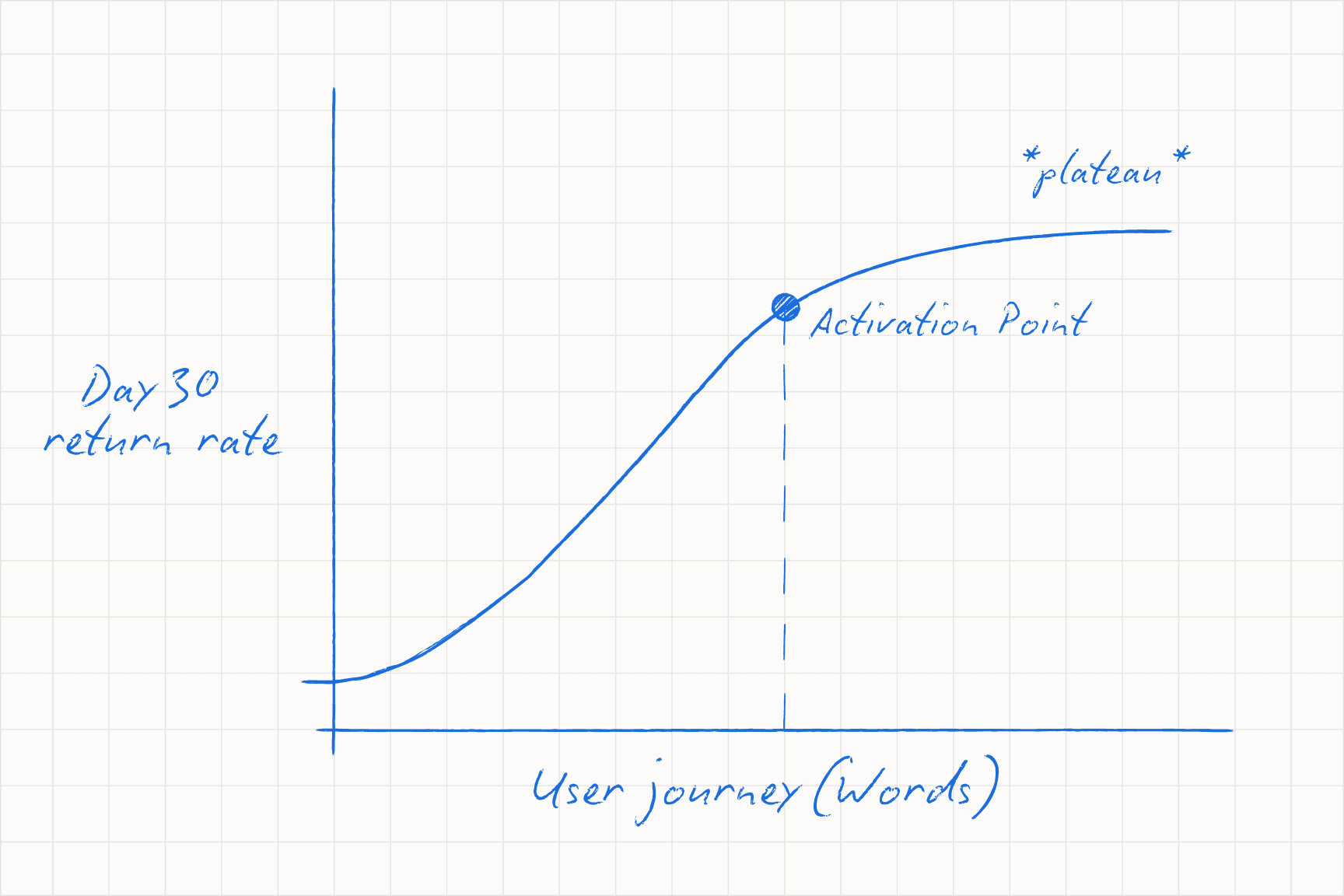
But you want to find the point where the likelihood of retaining thirty days later plateaus. You take points along the journey that your product team thinks are important. For a continuous engagement curve, that could be different word counts. For a company like Framer or Lovable, it could be publishing or sharing your first site.
Think about it as a chart. The y-axis is some meaningful retention metric (for us day-thirty return rate). The x-axis is the user journey. For each point in the journey, you map the likelihood of retaining. You find the point at which the curve starts asymptoting: where the likelihood of retaining thirty days later doesn’t change much if you go deeper in the funnel. If users go deeper, other things happen. They convert more, share more, and use more of the product. But for activation you only need the simplest retention metric to prove the user is utilizing your product frequently and over time.
Part of the work is figuring out which metrics are even the right candidates. We initially looked at the number of dictations, the number of times you hit the fn button and release. You’d expect that’s actually better: those are unique interactions with the product. But you don’t replace someone’s workflow based on how many times they’ve clicked a button. It’s the experience associated with each click: how long they’re spending using your product, how much they’re talking, and the quality of the transcription. I could dictate ten messages to Claude that are all one sentence, and one message to Claude that is ten sentences. Both end up feeling like you’ve used Wispr Flow the same amount. The aha comes from the continuity of the amount you can say and it just works.
Part of the work is figuring out which metrics are even the right candidates. We initially looked at the number of dictations, the number of times you hit the fn button and release. You’d expect that’s actually better: those are unique interactions with the product. But you don’t replace someone’s workflow based on how many times they’ve clicked a button. It’s the experience associated with each click: how long they’re spending using your product, how much they’re talking, and the quality of the transcription. I could dictate ten messages to Claude that are all one sentence, and one message to Claude that is ten sentences. Both end up feeling like you’ve used Wispr Flow the same amount. The aha comes from the continuity of the amount you can say and it just works.
You also want a metric beyond retention that activation correlates with: one that’s hard to game. DAU is gameable. We can spend money on new users, get people in the funnel, and our DAU goes up. At Wispr, we optimize for what we call currently engaged daily active users: someone who signed up more than a week ago and is still using the product. A user we paid to acquire that would have churned within a week might increase DAU, but they can’t increase currently engaged DAU. You can’t buy that number.
You also want a metric beyond retention that activation correlates with: one that’s hard to game. DAU is gameable. We can spend money on new users, get people in the funnel, and our DAU goes up. At Wispr, we optimize for what we call currently engaged daily active users: someone who signed up more than a week ago and is still using the product. A user we paid to acquire that would have churned within a week might increase DAU, but they can’t increase currently engaged DAU. You can’t buy that number.
Break priors with your product
We’re thrown a million products at our face every single day. Most of them don’t work as well as we’d like them to. So when someone tries your product for the first time, they’re skeptical. They have every prior that says it’s not going to be worth their while. Humans are incredibly anchored to these priors, because they’ve experienced the problems with other products in your space. To activate your users, you need your product to help them question and break those priors.
When we were rethinking our activation funnel at Wispr, we spent a lot of time doing in-person onboarding. Watching in-person shows you where users stop, lose focus, or feel the most delight. You can glean a lot from metrics, but time-on-page won’t tell you whether someone went away because they did something else or because they’re confused.
When we were rethinking our activation funnel at Wispr, we spent a lot of time doing in-person onboarding. Watching in-person shows you where users stop, lose focus, or feel the most delight. You can glean a lot from metrics, but time-on-page won’t tell you whether someone went away because they did something else or because they’re confused.
In-person onboarding is where I saw what people were missing: simply the belief they can whisper and speak at a normal cadence, with mistakes and all, and it will still work. The prior is that people don’t think dictation is very good. So when they tried Wispr Flow, they talked really slowly and spoke really loud.
In-person onboarding is where I saw what people were missing: simply the belief they can whisper and speak at a normal cadence, with mistakes and all, and it will still work. The prior is that people don’t think dictation is very good. So when they tried Wispr Flow, they talked really slowly and spoke really loud.
The only way to break a prior is by asking users to pressure-test it in the moment. Asking people to just whisper, and explaining the ergonomics of how to whisper, had a profound effect on getting people to experience the aha moment. It’s as simple as telling people: lean in close to the microphone and speak as quietly as possible. Once you’ve seen the impact of this in person, think about how to take that human-to-human experience and digitize it. For us, that meant creating an anthropomorphized product experience that achieves a similar result even without a real human walking users through their onboarding, and gets users to truly feel the value of the product upfront.
Malhar Singh
Head of Growth Product at Wispr Flow