Build your GTM brain

Maja Voje is the best-selling author of Go-To-Market Strategist, the methodology adopted by 10,000+ companies worldwide. Across fifteen years she’s driven growth for brands from Google to Heineken, helped scale 850+ startups, and today advises B2B teams on GTM AI strategy.
Every early-stage team is now competing in a sea of sameness — the same AI tools, signals, and outbound. Maja argues that the teams pulling ahead are the ones building systems that compound: a persistent GTM brain that gets smarter over time, pointed at the right customer, sending the message that actually cuts through.
Build a GTM brain
AI brought a lot of opportunities to our space, and a lot of problems. Open LinkedIn — 70% of what you see is AI-generated. Big freelance content teams are being replaced by smaller teams running intelligent systems. And outbound is drowning: everyone is being hit with the same emails.
The problem isn’t AI. It’s that most teams are still using it like a chatbot. Make me a LinkedIn post. I like this post — now make me something similar. The memory isn’t there. It will never remember who your ICP is, what your competitive advantages are, and eventually you run out of space or intelligence on the project. Prompting is actually the worst way to use Claude. The real unlock is context engineering: you upload your base information once, and it stays as a persistent window of context for everything that comes after. A team still prompting is running a chatbot. A team doing context engineering is running a brain.
The problem isn’t AI. It’s that most teams are still using it like a chatbot. Make me a LinkedIn post. I like this post — now make me something similar. The memory isn’t there. It will never remember who your ICP is, what your competitive advantages are, and eventually you run out of space or intelligence on the project. Prompting is actually the worst way to use Claude. The real unlock is context engineering: you upload your base information once, and it stays as a persistent window of context for everything that comes after. A team still prompting is running a chatbot. A team doing context engineering is running a brain.
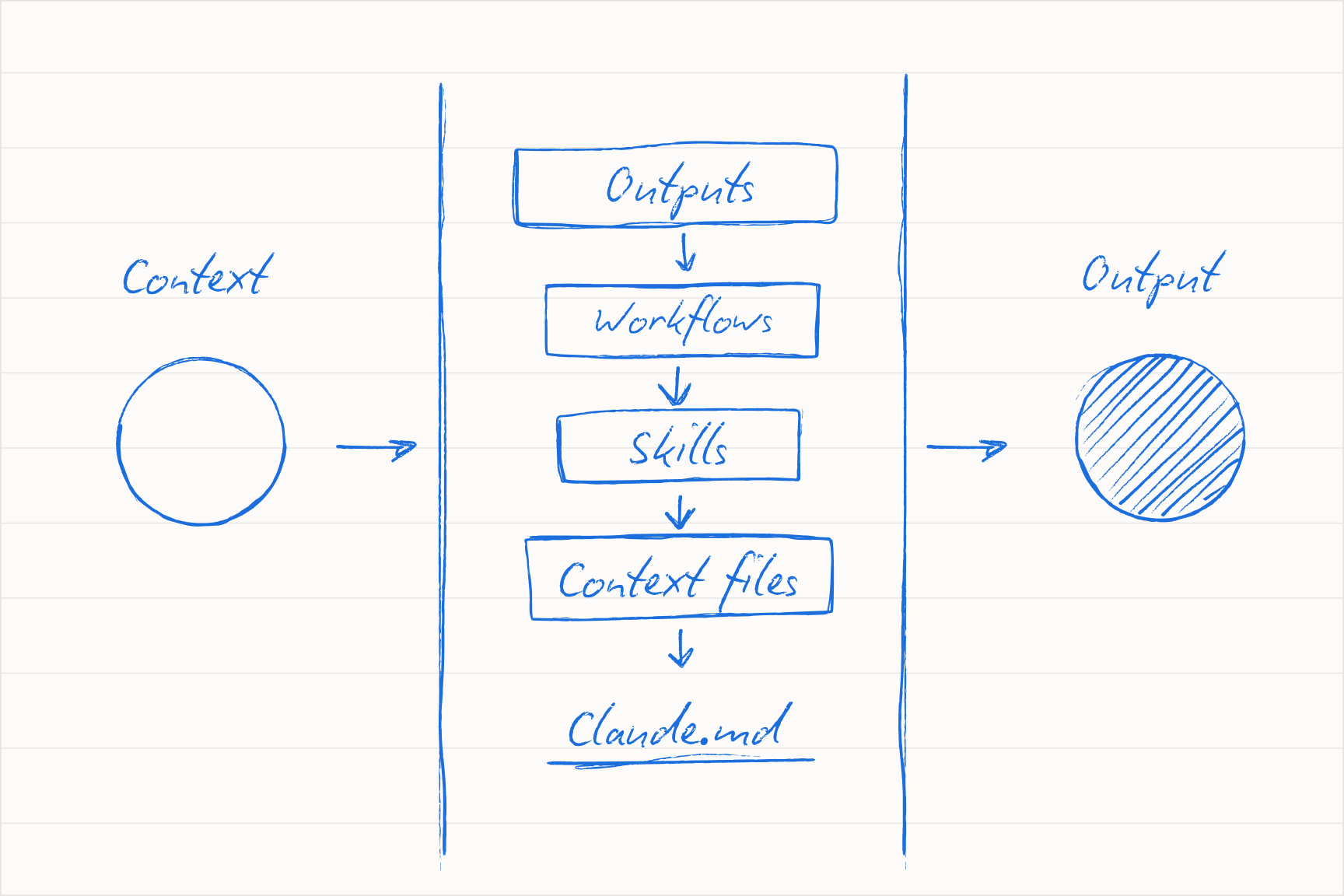
The GTM brain has five components.
- CLAUDE.md file, the single most important file: your ICP summary, positioning, current priorities. Keep it short and scannable — all the details should be in the context files.
- Context files that capture your GTM strategy in structured form: signal libraries, competitive battlecards, messaging matrices.
- Skills: markdown files that tell Claude how to run specific tasks using that context — account research, ICP scoring, signal-to-sequence.
- Workflows: decision trees and process specs for the humans running the system, not for Claude to execute.
- Outputs: everything the brain produces, archived alongside the context that produced it. Six months of outputs is a feedback loop: see how your thinking evolved, which campaigns worked, and how your ICP changed.
This is the best system for maintaining company intelligence that you can build right now. And for the very first time, even as a non-coder, you can really get some advanced work done. You can check out my full repository and guides in the GTM repository guide.
ECP comes before ICP
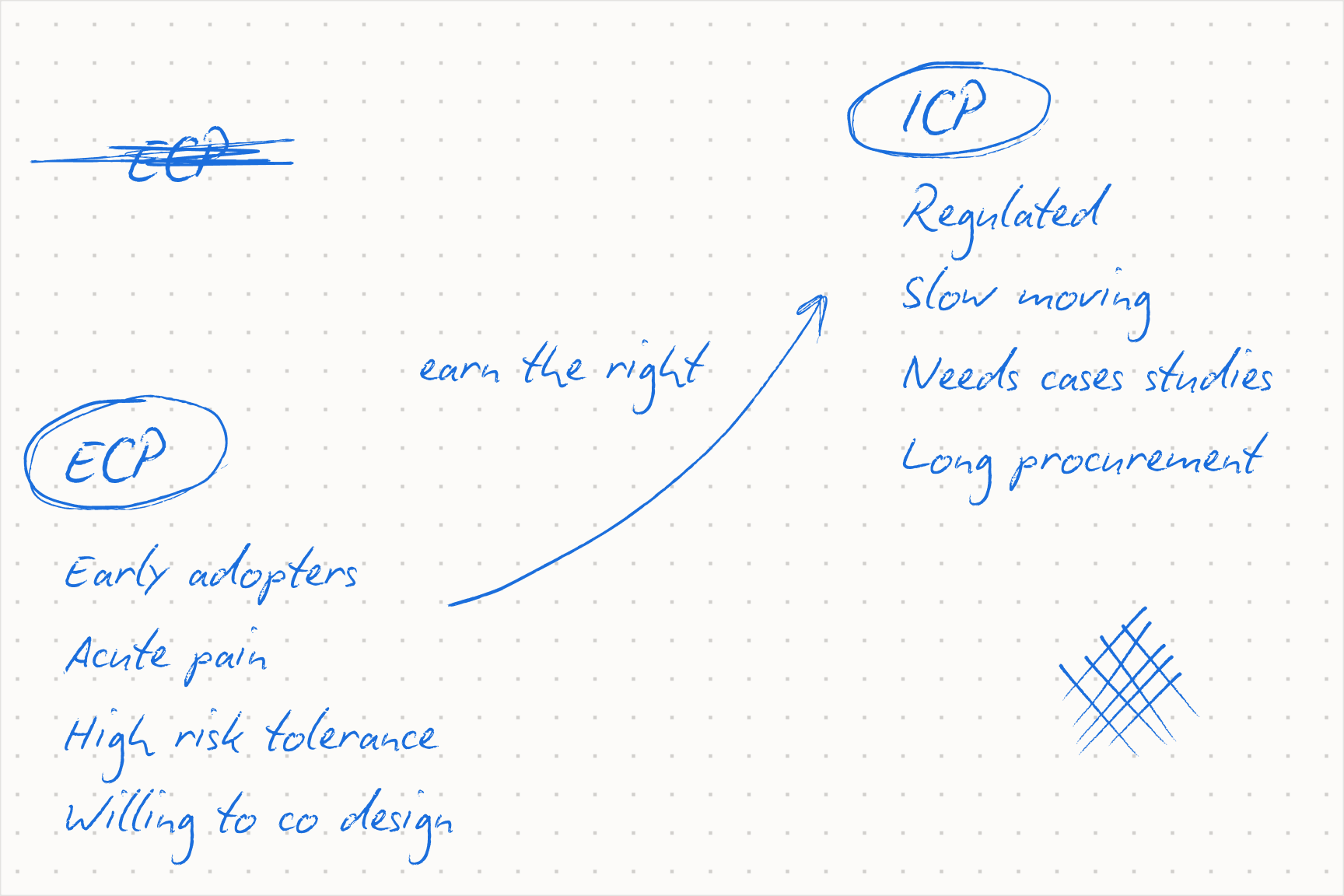
But a system only compounds if it’s pointed at the right people. When you’re early, this is your ECP. The whole idea of ECP before ICP is that you have to win early to earn the right to go upmarket toward your ICP. If your ideal customer is a regulated enterprise, they’ll require case studies, testimonials, and at least pilot projects before signing. So focus on what’s immediately obtainable: sub-segments of the market with burning pain points. Usually early adopters, with higher risk tolerance, willing to co-design, not blocked by compliance and negotiations that last a year. You might run out of runway while you’re still talking to your ICP.
But a system only compounds if it’s pointed at the right people. When you’re early, this is your ECP. The whole idea of ECP before ICP is that you have to win early to earn the right to go upmarket toward your ICP. If your ideal customer is a regulated enterprise, they’ll require case studies, testimonials, and at least pilot projects before signing. So focus on what’s immediately obtainable: sub-segments of the market with burning pain points. Usually early adopters, with higher risk tolerance, willing to co-design, not blocked by compliance and negotiations that last a year. You might run out of runway while you’re still talking to your ICP.
AI hasn’t changed this much, but there’s more enthusiasm for new technologies now and entry barriers are lower. You’ll still have to answer “who else is using this?” eventually. Just not on day one.
Qualification happens in four brackets
Then when you start getting leads, scoring gets messy fast. I still see people assigning extra points because someone downloaded an ebook — but in your best client portfolio, is that really a predictor of a sale? Maybe, in an ideal world, but not in most cases.
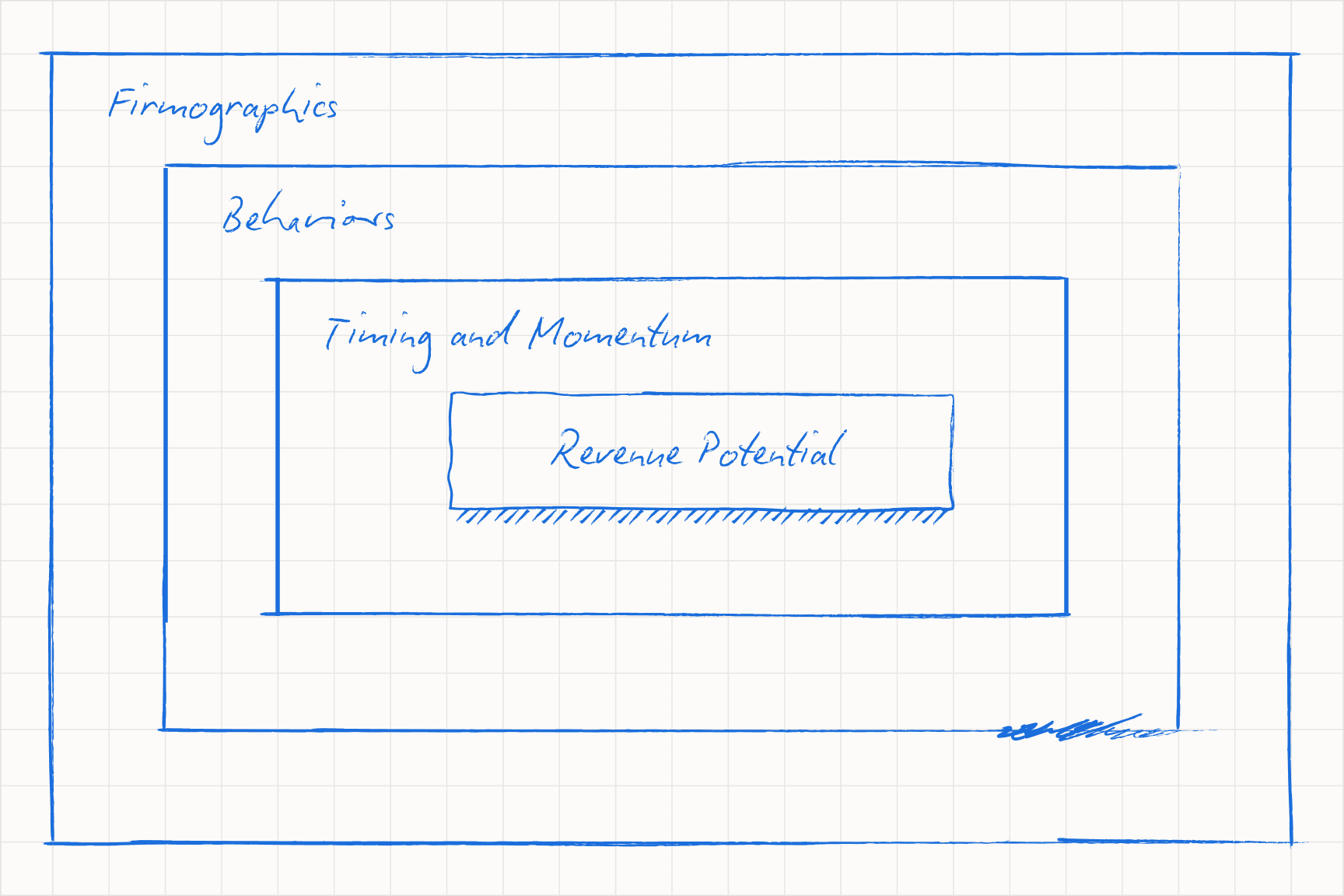
Every account worth looking at sits inside four brackets.
- Firmographics: industry, size, geography, are all table stakes. “Fifty to 250 employees in US tech” is two million companies on LinkedIn. You’re spraying and praying.
- Behaviors: separate conversion-indicative behavior from noise. Visiting your pricing page five times in four days is a signal. Liking your CEO’s LinkedIn post is not.
- Timing and momentum: the “why now” window. A company that received $2–5M in funding, three months after the round closed, is a sweet spot. You need to harvest that intelligence: funding events, regulation changes, a competitor shifting pricing.
- Revenue potential: a $100 prospect gets self-serve. A $100K prospect gets proximity and care. Don’t celebrate when Walmart lands on your website if you’re not selling to Walmart.
Once you have the brackets, reverse engineer the weighting from your actual traction. If you have even ten clients, ask: which ones do I want 500 more of? Pull their characteristics: deal size, time to close, ease of reaching them. Don’t build your ICP around the one-offs (I call these snow leopards). Feed call recordings and win/loss analysis into the brain. ICP isn’t a branding exercise. Always bring data, and revisit at least quarterly.
Once you have the brackets, reverse engineer the weighting from your actual traction. If you have even ten clients, ask: which ones do I want 500 more of? Pull their characteristics: deal size, time to close, ease of reaching them. Don’t build your ICP around the one-offs (I call these snow leopards). Feed call recordings and win/loss analysis into the brain. ICP isn’t a branding exercise. Always bring data, and revisit at least quarterly.
The sea of sameness
Ultimately, we’re all being sold the same system. Change jobs and you’re bombarded with identical emails. Show up at an event and hear the same pitch. Standing out has become mission critical.
Ultimately, we’re all being sold the same system. Change jobs and you’re bombarded with identical emails. Show up at an event and hear the same pitch. Standing out has become mission critical.
Three things cut through. First, proprietary signals: the ones you define from your product analytics. If an activated account invites five people from the same company, that’s the moment sales should reach out. Second, proprietary research: the research that even big teams skip. Don’t be afraid to spend a lot of time on one email. One intelligent, well-researched message beats fifty templated ones — we’re seeing 3–5x conversion rates, sometimes 10x, compared to traditional approaches. And third, with all the AI, human touch matters more than ever. People are pragmatic, but also emotional. We don’t mind AI-generated content as long as it adds value. At the end of the day, it’s one question: is this relevant to me?
Three things cut through. First, proprietary signals: the ones you define from your product analytics. If an activated account invites five people from the same company, that’s the moment sales should reach out. Second, proprietary research: the research that even big teams skip. Don’t be afraid to spend a lot of time on one email. One intelligent, well-researched message beats fifty templated ones — we’re seeing 3–5x conversion rates, sometimes 10x, compared to traditional approaches. And third, with all the AI, human touch matters more than ever. People are pragmatic, but also emotional. We don’t mind AI-generated content as long as it adds value. At the end of the day, it’s one question: is this relevant to me?
Maja Voje
Founder at The GTM Strategist