Gen marketers do less, better


Emily Kramer spent the last decade advising B2B startups. She led and built marketing teams from the ground up at Asana, Carta, Astro (acquired by Slack), and Ticketfly. She’s been the first-ish marketer 4 times, joining companies at 10 to 300 people. Now, she helps hundreds of B2B founders and marketers and reaches millions through her content on LinkedIn and Substack.
The first marketer at most early-stage companies is trying to do everything. Emily thinks that’s the wrong instinct: the teams who pull ahead aren’t the ones doing more, they’re the ones doing less, better. In this entry, Emily shares her takes on qualification, covering:
Random acts of marketing
AI has given early marketing teams more tools, more channels, and more ways to create content than ever before. The problem is that more is not more. I’ve been talking about this for years, but AI has made it worse: so many teams just do what they’ve always done, copy what they see other teams do, and say yes to every founder request. They don’t think deeply about which box is actually worth checking. I call it RAM: random acts of marketing.
What separates the teams that win is focus: doing the things that will work for their company specifically, for who they uniquely are, and letting everything else fall away. I see so many companies with a TAM of a thousand companies waiting for inbound. Why? You can enrich all that data. Go out and get them. It’s a different game now, and it requires a different kind of marketer.
The gen marketer
To beat RAM, you need to be really tight on combining what I call fuel and engine. Fuel is all of the content, messaging, creative. All the stuff that you create. The engine is how you distribute it. If the people working on your fuel are completely detached from your engine, you’re just not going to be able to be successful.
You need someone who can orchestrate across all the sub-functions, see across the board, and run campaigns that combine fuel and engine. You need to move faster than ever now, and having all those handoffs between teams creates unnecessary friction.
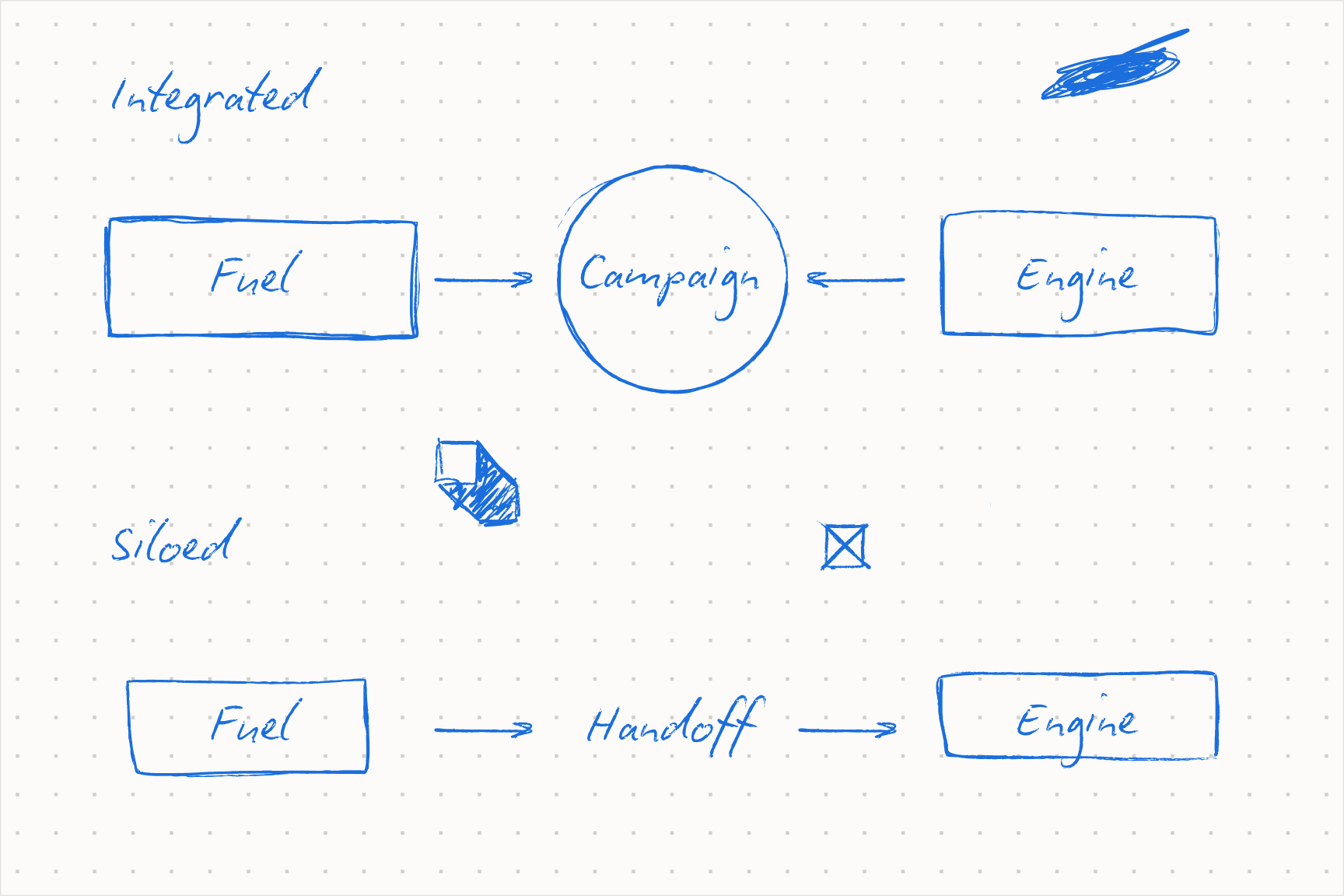
I call this person a gen marketer: a generalist who is excellent at generating campaigns that combine fuel and engine, thinks in big-bet campaigns that make you stand out and be differentiated, and is amazing with generative AI. Not just RAM, but campaigns that are actually going to move the needle for your specific company.
I call this person a gen marketer: a generalist who is excellent at generating campaigns that combine fuel and engine, thinks in big-bet campaigns that make you stand out and be differentiated, and is amazing with generative AI. Not just RAM, but campaigns that are actually going to move the needle for your specific company.
Part of that focus is knowing which channels are worth your time. For example, I’m really bullish on events and ecosystem marketing (working with partners and piggybacking off of other people’s audiences) whether that’s another company, an influencer, or an agency.
Part of that focus is knowing which channels are worth your time. For example, I’m really bullish on events and ecosystem marketing (working with partners and piggybacking off of other people’s audiences) whether that’s another company, an influencer, or an agency.
When you are a new company, you don’t have old workflows and old habits to break. One of your big advantages is speed of adopting AI. Finding a gen marketer who’s really gone deep in AI and agentic workflows is a real leg up for your whole company.
Your website is mid-funnel now
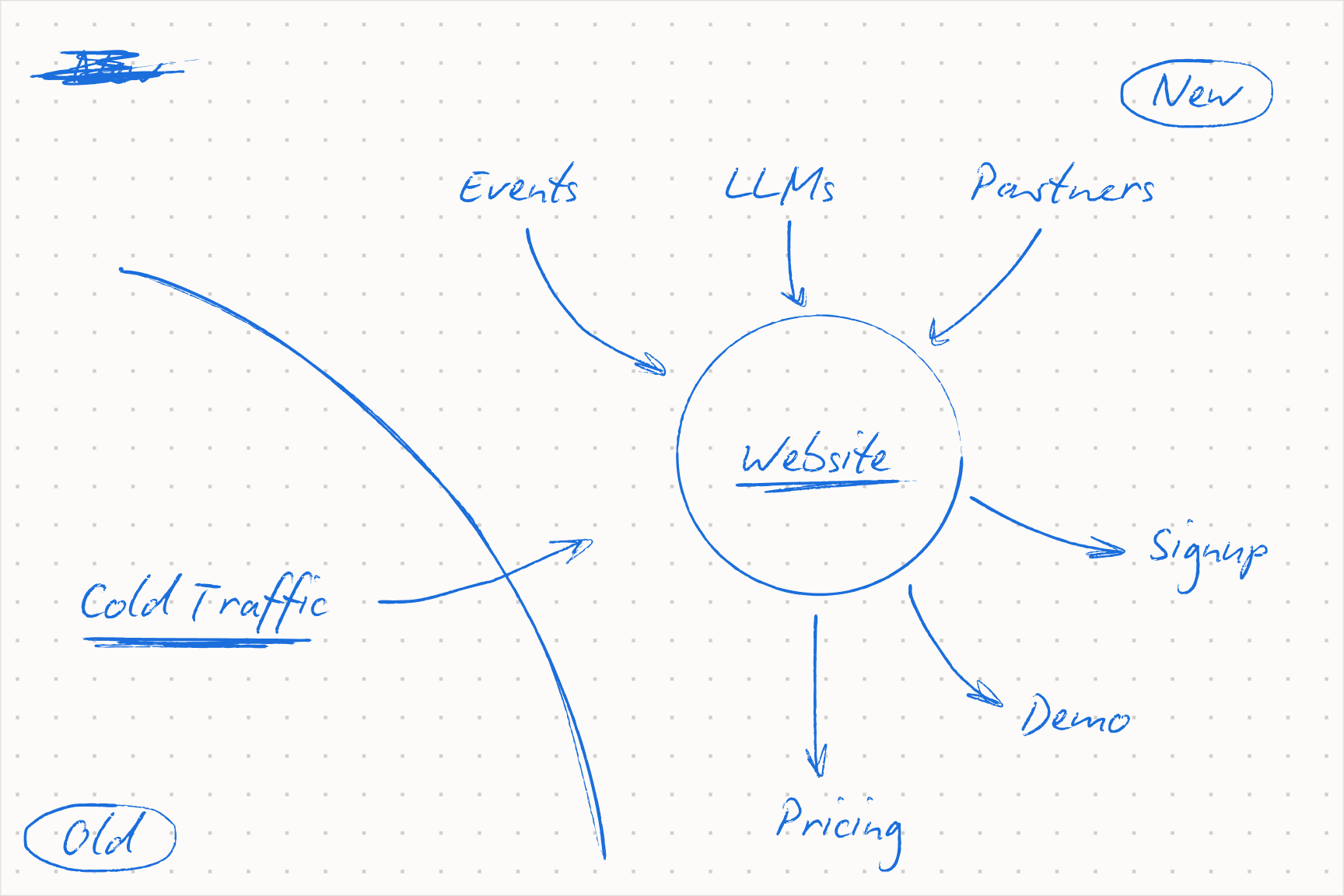
Take your website as another example: it’s no longer a top-of-funnel asset. What we write is parsed by LLMs and then rewritten by them. You’re losing some of that control. Some of these things might never get read by humans at all, which is a fundamental shift in how we think about creating content. It is okay to have a text file on your website not formatted for a human to read.
Traffic is fundamentally going to be lower than it was before because people are getting answers from LLMs. So when they get to your website, you need to do everything you can to convert them. LLMs will scour the internet and find your pricing no matter what you do, so put it in a structured format that both can read. Put meeting booking in your demo flow.
Stop gating. It kills shareability and the data is available to you anyway. You cannot skip the basics on conversion because traffic is more scarce. The website is no longer where you figure out who your customer is. You should already know.
Accounts before contacts
We have all of this data now. Stop net fishing and waiting for everyone to come to you. Do account research, niche down your audience, and systematically pursue the ones that fit. Attribution is still important, but what matters more is: have they interacted with your content? What activities happened along the way?
We have all of this data now. Stop net fishing and waiting for everyone to come to you. Do account research, niche down your audience, and systematically pursue the ones that fit. Attribution is still important, but what matters more is: have they interacted with your content? What activities happened along the way?
We are so obsessed with leads and we don’t think nearly enough about the accounts we want. Often it’s a multi-person sale. People just think about contacts in isolation and not how that all ladders up. They do the wrong research. Stop thinking about lead capture and qualification and start thinking about which accounts are even aware of you, or what stage they’re at.
Kill MQL and SQL
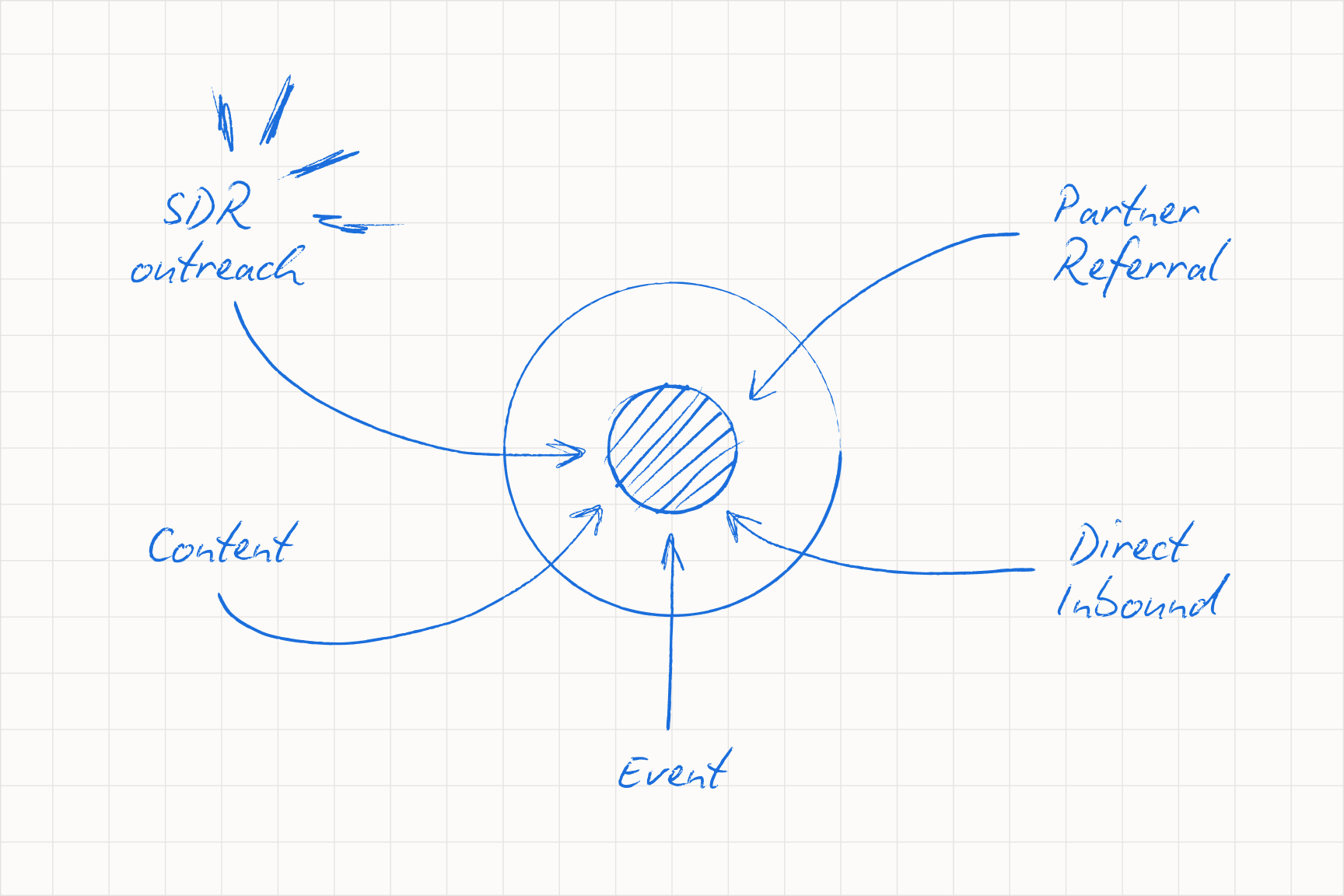
When you’re going after whole accounts with multiple people involved, labels make that harder. Using terms like MQL and SQL creates territorialism that’s completely unnecessary. The buying journey is not linear. These are milestones, not handoffs. It’s just false that someone’s handled by marketing and then handed off to sales.
We’re seeing more outbound happening earlier than ever, done by SDRs, go-to-market engineers, marketing, sometimes all at once. It just creates this fight: marketing didn’t deliver us enough, sales isn’t converting enough. Strip away the titles. We’re all trying to get people that are qualified and hand-raising, then go full force on them to book a meeting. Let’s be in that together, no matter who’s doing what.
Emily Kramer
Founder at MKT1