Attachment is the signal


Shreman Shrestha was the first GTM hire at Granola, the AI notepad for meetings, where he launched Granola Enterprise and built the sales motion from scratch. From hiring the first two AEs to launching the Enterprise plan, Shre has helped scale Granola’s GTM engine from 0 to 1, through to its recent Series C round and $1.5 billion valuation.
For a PLG product like Granola, free-to-paid conversion was never the metric that told them whether they were winning in the early days. Shre explains how the signal that mattered for Granola was user attachment, and every successful conversion tactic flows from reading that signal accurately: in the data, in who shows up in the inbound form, and in how fast they move once they do.
The signal to look for is user attachment
When it comes to conversion, the question you need to care about is: how do you go from a non-attached user (someone who doesn’t have an opinion on your product) to an attached one?
In the early days of Granola, we didn’t enforce our paywall for some of our most active users. That was intentional. What we cared about was user attachment and did not want anything to hinder or complicate that.
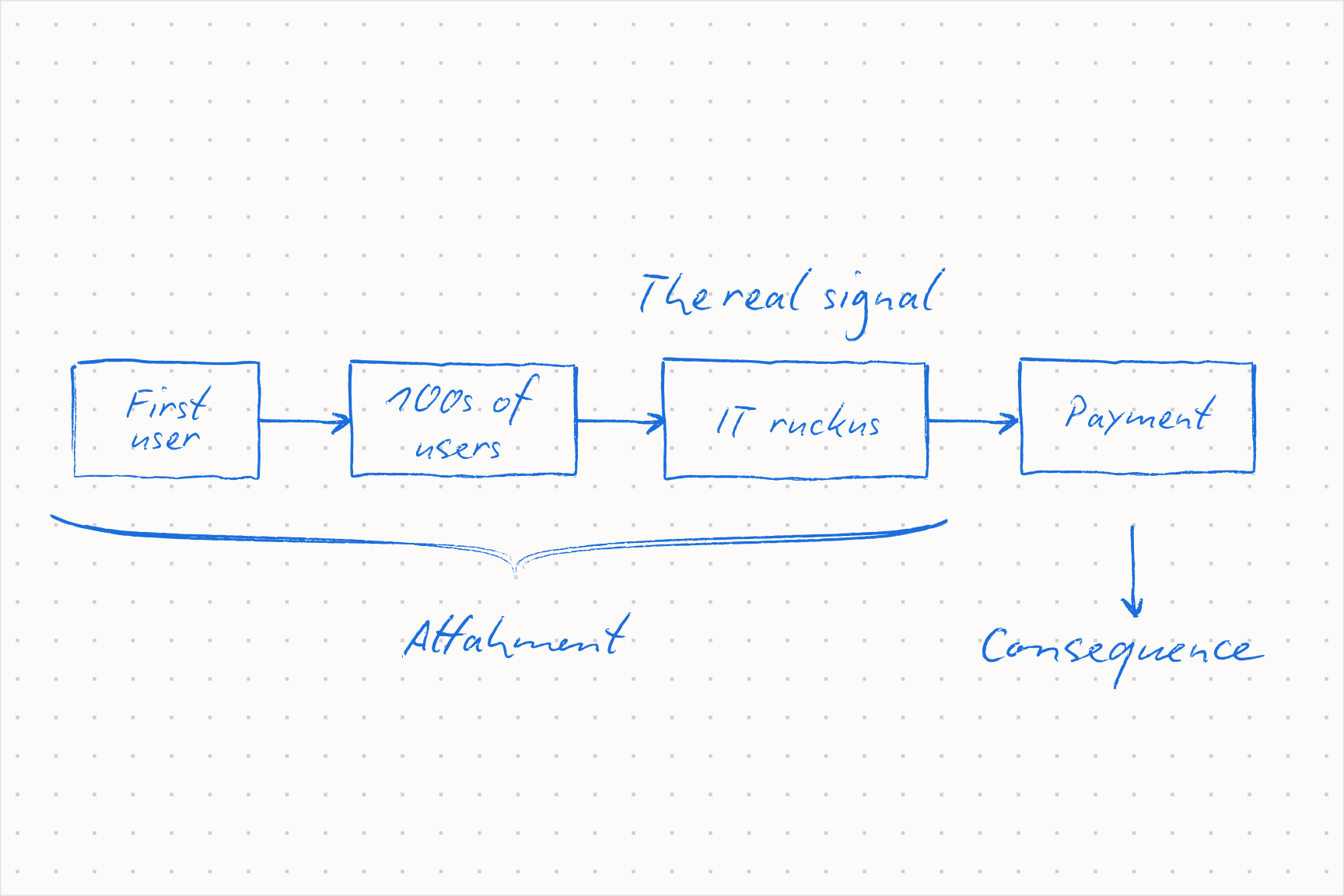
The earliest signs of PMF for Granola came from a single active user. They’d tell their team, and suddenly dozens or hundreds more would sign up, without me lifting a finger. Then the security team would find out, have no idea what Granola was, and either kick off a sales conversation or cut off access entirely. I’ve seen the screenshots champions send when shutting Granola down causes a stir. I’ve watched it happen at tiny startups and at public companies worth more than $100 billion.
The earliest signs of PMF for Granola came from a single active user. They’d tell their team, and suddenly dozens or hundreds more would sign up, without me lifting a finger. Then the security team would find out, have no idea what Granola was, and either kick off a sales conversation or cut off access entirely. I’ve seen the screenshots champions send when shutting Granola down causes a stir. I’ve watched it happen at tiny startups and at public companies worth more than $100 billion.
That’s the moment you’re measuring. Payment is the consequence. The ruckus is the user’s attachment to the product. Enforcing the paywall too early would have complicated getting our most active users to continue using Granola and spread the word about us. We forget that a lot of software tools at larger companies are enforced by IT and procurement, not chosen by individual employees. The level of user attachment we saw made it clear that once users heard about Granola, they typically choose to use Granola. And once they tried us out, they wanted Granola to stay.
Don’t overcomplicate the metrics
The data to watch is simple. Number of users at an account, and intensity of use. How quickly users at company X grow over weeks. The more users inside a single company, the more interesting things get.
Then the question is whether they showed up, tried it for a day, and stopped, or whether they’re using it every day.
Pilots are the cleanest version of this. When the other company caps a pilot at 10 users and you watch that number move to 20, to 50, to 100, to 500 within a month… that’s a pretty clear signal. We only built a post-sales function, Customer Success, in December 2025 so while I’d love to claim credit for this, it really is the product that did the work.
Five seats can beat fifty
Some of our earliest enterprise annual deals were as low as five users. But if you looked up who those five were, they were typically the founders or C-level. Five seats can be a bigger signal than fifty, depending on which five.
Granola is 100% inbound. So the inbound form is a pre-qualification layer. I’ve had founders and CEOs of companies worth billions literally fill it out and ask me, how do I buy this.
The other thing to read is urgency. Are replies coming in two weeks or within a few hours? Did you exchange Slack Connect invitations in the first meeting? How responsive are power users and champions when you ask for user feedback and share deal updates? There are prospects I have on WhatsApp from the first meeting, including one founder of a $100B public company. That kind of pace is a proxy for conversion likelihood that you will reliably never see in a usage dashboard.
Champion and decision-maker are not the same person
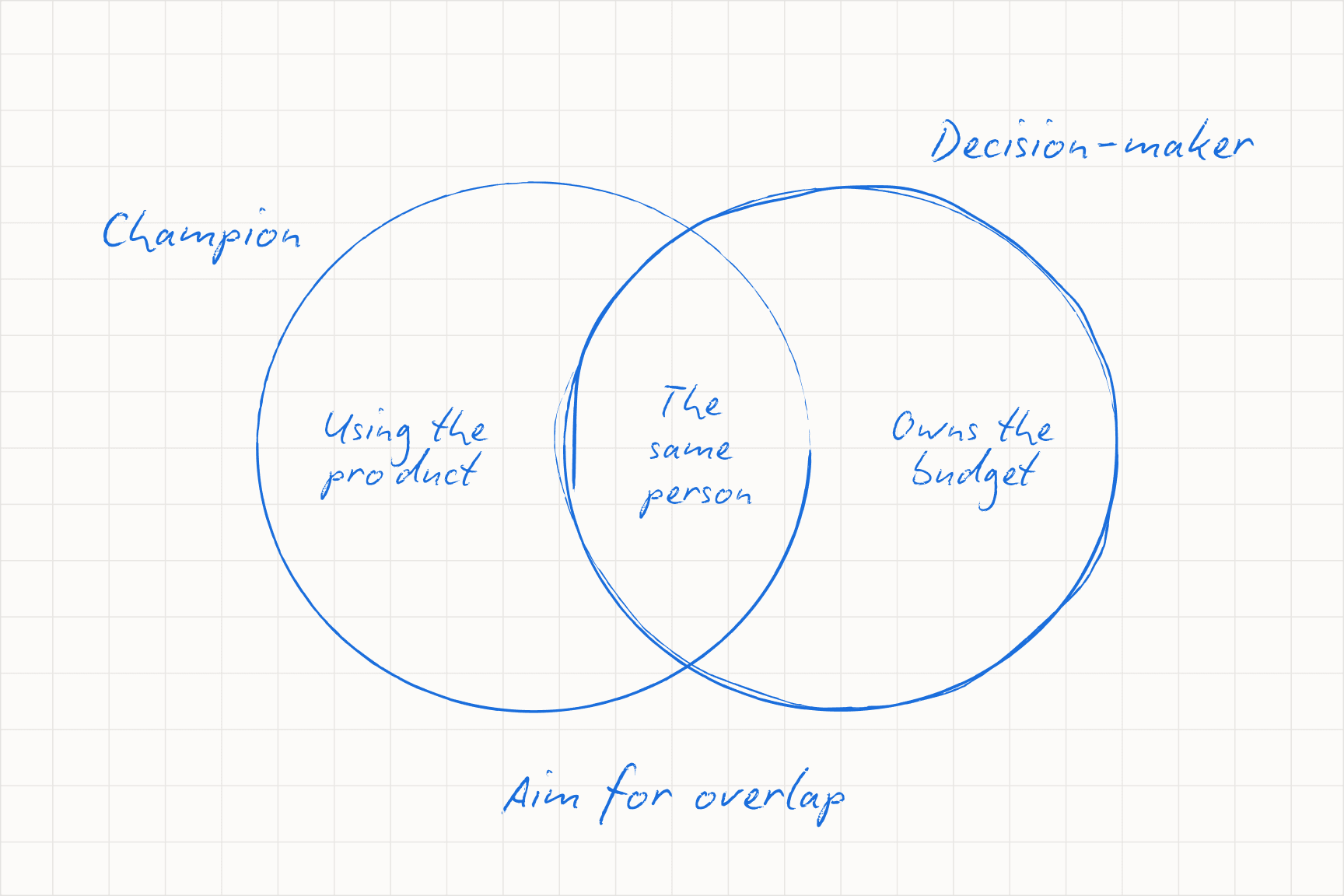
A champion is someone who uses the product a lot. A decision-maker is someone who can directly or indirectly influence the procurement cycle: legal, security, finance. Typically an executive. The best world is when those are the same person. Someone who cares, and who can directly push the purchasing decision through. The second-best world is a strong champion who can thread the executive for you. Anything else is either slow or stuck.
What actually moves deals is making sure the champion has the right information, not more collateral. The common pressure points for us are predictable: people assume we record audio and video, and we don’t, we do live transcription, so you anticipate those and have the answer ready. After a few revs, you know the objections before they come.
The rest is an open dialogue. The motion works because people like the product. We don’t have battle cards or spend hours on a deck. I know that may sound atypical. It is, but it works because the product is already doing much of that work.
Urgency is your strength
For the first six months of 2025, I was the only salesperson at Granola. That’s a real forcing mechanism when you’re one person and dealing with hundreds in organic inbound every week. I can’t draw a hyper-detailed diagram for your security team. Being upfront about things like that — that it’s just me, one lawyer, and reserved legal bandwidth — is often what actually moves things when you’re early.
For the first six months of 2025, I was the only salesperson at Granola. That’s a real forcing mechanism when you’re one person and dealing with hundreds in organic inbound every week. I can’t draw a hyper-detailed diagram for your security team. Being upfront about things like that — that it’s just me, one lawyer, and reserved legal bandwidth — is often what actually moves things when you’re early.
Smallness helps on the product side too. When enterprise asks for a feature list, we push: we’re one engineer: if we point that engineer in one or two directions, which is it? You find out fast what’s actually a must-have, and what was just on the list because every other vendor has it. There’s only so much you can vibe code in the world of Enterprise product and security needs.
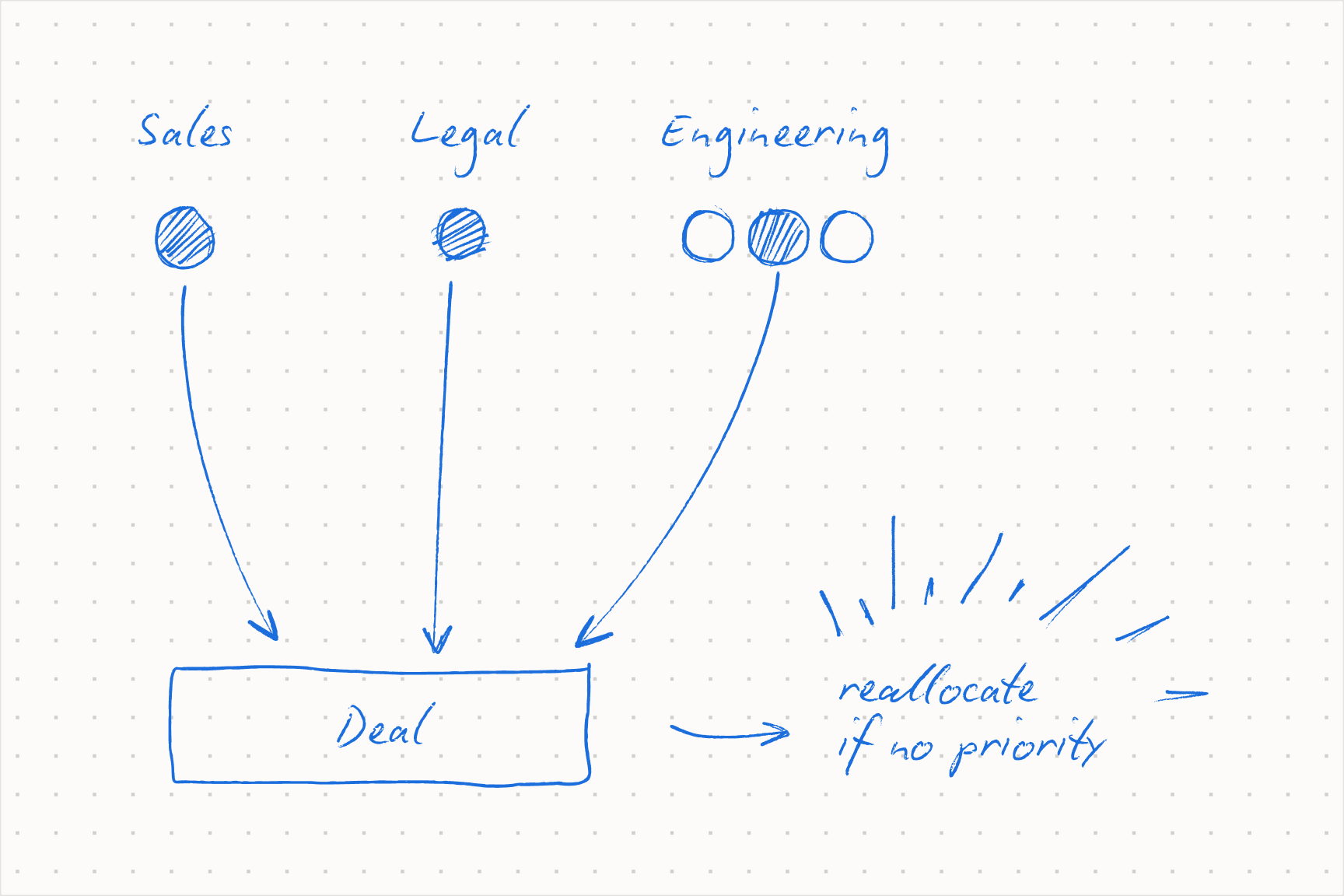
This was Granola Enterprise in the early days (the first six months of 2025). I’m thrilled to see us grow to a sales team of a dozen-strong across both San Francisco and London. We’re hiring and obviously, actively selling!
Shre Shrestha
Head of Business at Granola